|
|
|

|
 |
| GENERAL |
| Always
apply in accordance with the relevant specifications. Further
information may be obtained from Pollyaim Ltd. |
| The
substrate to be coated should be sound, smooth and free from
sharp projections. Ensure surface to be coated is dry and free
from dust and other loose materials, oil, grease, etc. Internal
corners should be profiled using an appropriate 50mm fillet
and external corners chamfered.
Apply
primer to the substrate by brush
or roller at a rate of 6 to 8 sq.m.
per litre and allow to dry. Primer
coverage will vary significantly
depending upon the porosity of the
substrate. Only prime an area sufficient
for covering within the working day.
Do not prime overlap areas.
|
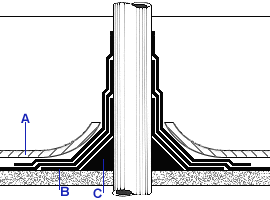
A - Pollyseal "O" series
protection board
B - Pollyseal self-adhesive membrane star cut around pipe.
C - Preformed or bitumen mastic fillet.
|
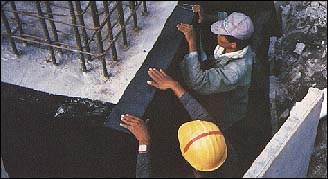
| Ensure
correct alignment of the roll, peel back approximately 50cm
of the release interleave and place the exposed adhesive onto
the appropriate starting position. Holding the paper in both
hands, pull evenly so that the roll unwinds. Alternative methods
may be required on vertical, sloping or uneven surfaces.
Pollyseal
Membranes, which employ a selvage
strip, should have the protective
siliconised film removed immediately
prior to application of the overlapping
sheet. As the laying proceeds, the
membrane should be pressed onto the
substrate by smoothing down from
the centre to the edges to exclude
any trapped air pockets.
|
| Subsequent
rolls should be overlapped onto the backing film by at least
5Omm at the sides and 100mm at the roll ends. The areas to
be overlapped must be clean and free from dust prior to lapping
and should be pressed firmly down to obtain a watertight
joint. The use of a small roller assists this operation.
It
is recommended that large horizontal areas are rolled
using a suitable heavy soft faced roller.
Vertical
application of membrane requires the top edge to be 'chased-in'
and linked to other waterproofing installations. During
the construction phase it may be necessary to temporarily
secure the top edge of the membrane by battening.
|
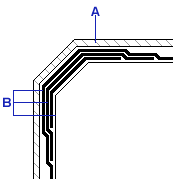
A
- Pollyseal "O" series protection board secured
with pollystik and boards joined with pollyseal reinforcing
tape.
B - Pollyseal
self-adhesive waterproof membrane.
|
| Pollyseal
is liable to damage when subjected to high mechanical stress
prior to or during backfilling. It maybe necessary to protect
the membrane from damage by use of protection board such
as a Pollyboard "O" Series protection board.
If
during the construction phase the Pollyseal system is
left exposed for prolonged periods it should be covered
and the exposed edges sealed with a band of Pollyseal
Mastic.
The membranes
should always be covered by screed, paving or soil as soon
as possible after installation. Permanently exposed sections
such as parapet wall up stands should be protected with
Pollyshield or Pollyseal Solar Shield.
|
|
|